
Checking Criminal History in Traverse City
Begin at the Traverse City custodian closest to the event. Central Records holds releasable TCPD reports and accepts written requests. An in-person arrest-record check requires identification. Court searches answer a different question: the 86th District docket covers misdemeanors and early felony stages, while a bound-over felony continues in 13th Circuit Court. Michigan ICHAT can add a statewide public summary after qualifying information reaches the state repository.
- Ask whether TCPD, another agency, or a court created the record.
- Request a TCPD incident or arrest report from Central Records with enough event details to locate it.
- Search 86th District Court for a Traverse City misdemeanor, traffic matter, or the preliminary phase of a felony.
- Follow a bound-over felony into 13th Circuit Court, and call county Corrections for current local custody.
- Use Michigan ICHAT for qualifying public statewide history, while remembering that it omits warrants and full source documents.
A name can produce possible matches. A report or complaint number and a court case number are far stronger keys. Compare dates of birth, event dates, and case status before treating two records as the same event.
Traverse City Records at Woodmere
The Sergeant Dennis W. Finch Law Enforcement Center brings Traverse City Police, the Grand Traverse County Sheriff, and shared Central Records into one building at 851 Woodmere Avenue. That arrangement is unusually useful when an event involved both city and county personnel, but it does not merge their legal custody of every record. Ask which agency owns the report and direct the request to that custodian.
Central Records can be reached at 231-995-5005. The Traverse City page lists weekday hours of 8:00 a.m. to 4:30 p.m., except holidays. Written TCPD FOIA requests may go in person, by mail, by email to tcpdfoia@traversecitymi.gov, or by fax to 231-929-0745. Nonemergency dispatch is 231-922-4550, and the after-hours vestibule phone connects to dispatch.
The office and its release channels appear on the Traverse City Central Records source.
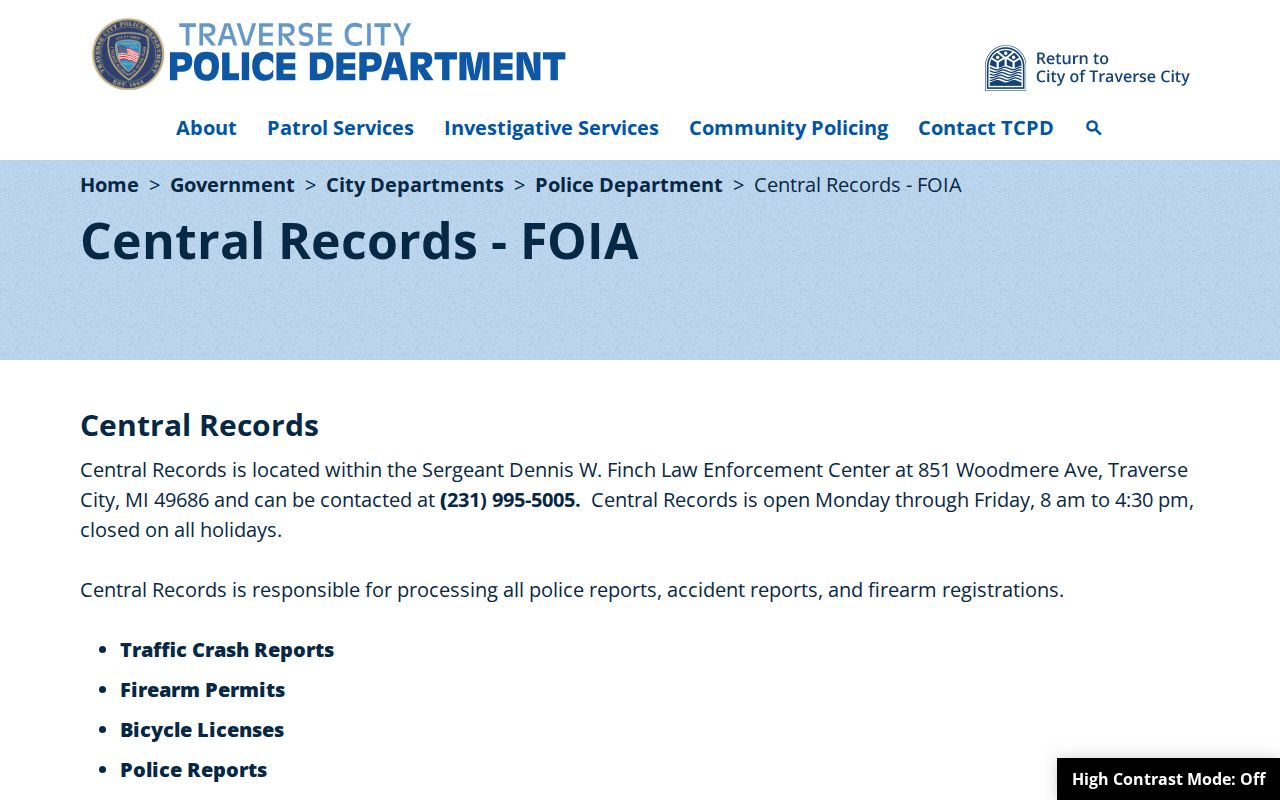
The shared location makes it easier to route a request, yet the form should still name TCPD when a Traverse City police report is sought.
Traverse City Police Department Records
TCPD, led by Chief Matthew G. Richmond, creates records tied to police response inside its jurisdiction. These may include incident narratives, arrest materials, fatal-crash files, crash supplements, photographs, and digital media. Some portions can be withheld or redacted when Michigan law protects active investigations, victims, minors, personal identifiers, or other exempt information. The police report records what officers received, observed, and did. It does not replace a court disposition.
Traverse City asks for a written FOIA request for police reports and the listed crash materials. A clear request gives the report or complaint number, involved names, date and time, location, and the exact material wanted. Ask for a narrative, supplement, photograph, audio, CAD or 911 material, or video by name instead of saying “everything.” The city may respond within five business days or take the allowed ten-business-day extension.
TCPD Central Records
851 Woodmere Avenue
Traverse City, MI 49686
231-995-5005
Weekdays, 8:00 a.m. to 4:30 p.m., except holidays
The department’s official identity and services are shown on the Traverse City Police Department page.
That department is the source for its own police files, even after later charge and disposition data moves through county and state systems.
Requesting Traverse City Police Records
The TCPD request form captures both delivery choices and search details. It asks for the requester’s name, phone, organization, fax, street or email address, city, state, and ZIP. The person can request a copy, a certified copy, onsite examination, or digital media. Delivery choices include pickup, onsite copies, mail, and email. A narrative field describes the record and attachments, while an optional signature can consent to a response-time extension.
Use a narrow request when only one part of a Traverse City file matters. A complaint number may locate an incident faster than a broad name search. For an arrest-record check, TCPD directs the person to appear with identification. Fees can vary with the task and media; the reviewed city material did not publish one flat amount for every request.
| Requester Details | Name, contact information, organization, and mailing or email address. |
|---|---|
| Record Description | Specific incident, report number, names, date, location, and requested attachments. |
| Format | Copy, certified copy, onsite examination, or digital media. |
| Delivery | Pickup, onsite copies, mail, or email. |
| Extension | Optional consent with signature and date. |
Traverse City Arrests and Bookings
Traverse City has no advertised current city jail. When TCPD makes a custodial arrest, booking occurs through the Grand Traverse County Correctional Facility at 320 Washington Street. TCPD keeps its incident and arrest report, while county Corrections creates the intake and custody record. The 24-hour jail information line is 231-922-4530. A recent event can reach the jail before a court case becomes easy to find.
At booking, the records may include identity confirmation, property, health screening, photograph and fingerprints when required, the charge or hold presented at intake, bond, and release status. None of those fields proves guilt. The prosecutor can decline or change a charge, and the court can dismiss, amend, or decide it. The dedicated Grand Traverse County arrest lookup covers the county custody channels in more depth.
TCPD’s official records answers explain its local report and arrest-record routes.
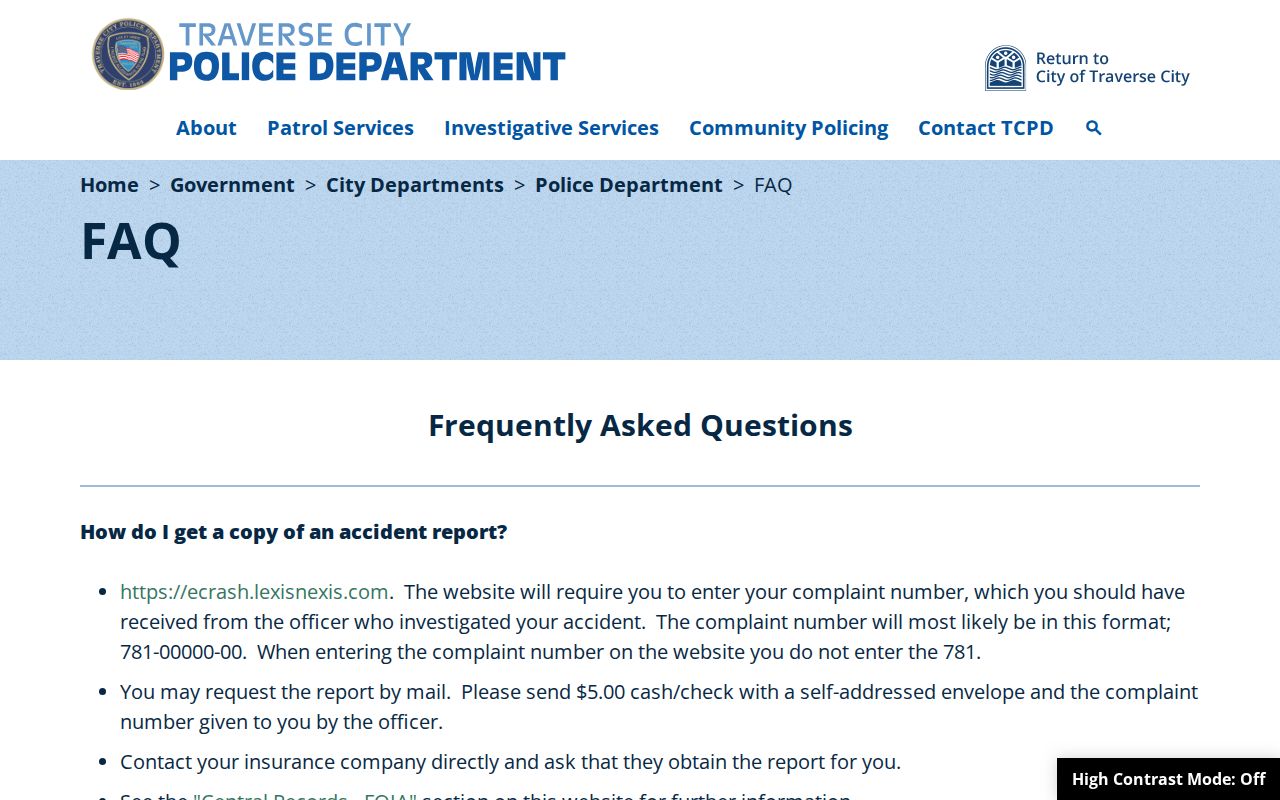
The official answers reinforce that an agency arrest check and a county jail record describe different parts of the same Traverse City event.
Reading Traverse City Police Statistics
TCPD sorts activity into Criminal, Non-Criminal, Traffic Crashes, and Other. “Other” can include 911 hangups, be-on-the-lookout notices, follow-ups, motorist assists, public relations, paper service, traffic stops, and warrant attempts. A call total is therefore not a conviction count, and even a Criminal category is an incident classification rather than a court judgment.
Traverse City’s resident population does not tell the whole demand story. The city says its daytime population more than doubles, with more than 200 locally owned downtown businesses and 50 restaurants. Those facts help explain why raw calls and reports should not be divided by resident population and labeled a personal crime risk. For current figures, filter the MSP Crime in Michigan Dashboard by the actual reporting agency and year.
- Incident
- An agency-recorded event, not a finding of guilt.
- Disposition
- The court’s outcome for a charge or case.
- Other activity
- A broad TCPD category that includes many non-criminal service and follow-up events.
Municipal Court Records in Traverse City
Traverse City does not operate a municipal court. City ordinance matters, traffic cases, misdemeanors, and the preliminary stages of felony cases route to 86th District Court. A felony that is bound over moves to 13th Circuit Court for later proceedings. Any claim that a Traverse City municipal docket exists would point readers to the wrong custodian.
| Court Name | No Traverse City municipal court; use 86th District Court and, after felony bindover, 13th Circuit Court. |
|---|---|
| Case Types Heard | District handles ordinance, traffic, misdemeanor, felony arraignment, probable-cause conference, and preliminary examination matters. |
| Case Lookup Channel | Use the county’s 86th District access page; use the separate 13th Circuit civil and criminal search after bindover. |
| What the Docket Shows | Case number, filing and status data, charges, events, hearings, disposition, and public financial entries as available. |
| Copies and Fees | District publishes $2 per page and $10 certification per case, plus $2 for each additional page. |
The 86th District Court access page requires acceptance of its disclaimer before a public search.
Traverse City Records Across Two Counties
Traverse City straddles Grand Traverse and Leelanau Counties. The city had 15,678 residents citywide in the 2020 census, with 15,279 in Grand Traverse County, and its July 2025 estimate was 15,832. A Traverse City mailing address alone does not settle which county court holds a case.
Check the event location and the court named on a citation, complaint, bond paper, or notice. A TCPD report may still be available through city Central Records, but the court file follows the court with geographic and subject-matter authority. Do not force every Traverse City criminal record into the Grand Traverse portal. If a local result is missing, verify whether the event fell on the Leelanau side and ask TCPD for the report number or court routing.
Where Traverse City Records Go
A Traverse City event develops into several records. TCPD writes the incident or arrest report. If there is custody, county Corrections books the person. The prosecutor decides which charges to authorize. The 86th District Court opens misdemeanor cases and the early felony stages, and a bound-over felony becomes a 13th Circuit file. Qualifying fingerprints, arrest data, and later dispositions flow to the Michigan State Police Criminal Justice Information Center.
Record flow: Traverse City Police Department › Grand Traverse County Courts › Michigan State Police CJIC
That flow explains why one source can lag or disagree with another. A police allegation may change before filing. The final conviction may differ from the booking charge. ICHAT is a repository summary, not the TCPD narrative or full court file. For self-review, compare each record and ask the originating city agency or court to correct its own data.
Traverse City Online Police Reports
TCPD online reporting creates a new report. It is not a criminal-record search. The channel is limited to nonemergencies within city limits when there is no known suspect and no physical evidence. Accepted categories include listed lost-property matters and limited misdemeanor, property, or fraud reports. A successful submission produces email verification and later a complaint number.
If a suspect is known, evidence must be collected, the event is outside Traverse City, or prompt officer response is needed, use the appropriate dispatch channel instead. Save the complaint number because it becomes the key for a later Traverse City record request. An emergency still goes to 911.
The criteria can be checked on the official TCPD online reporting page.
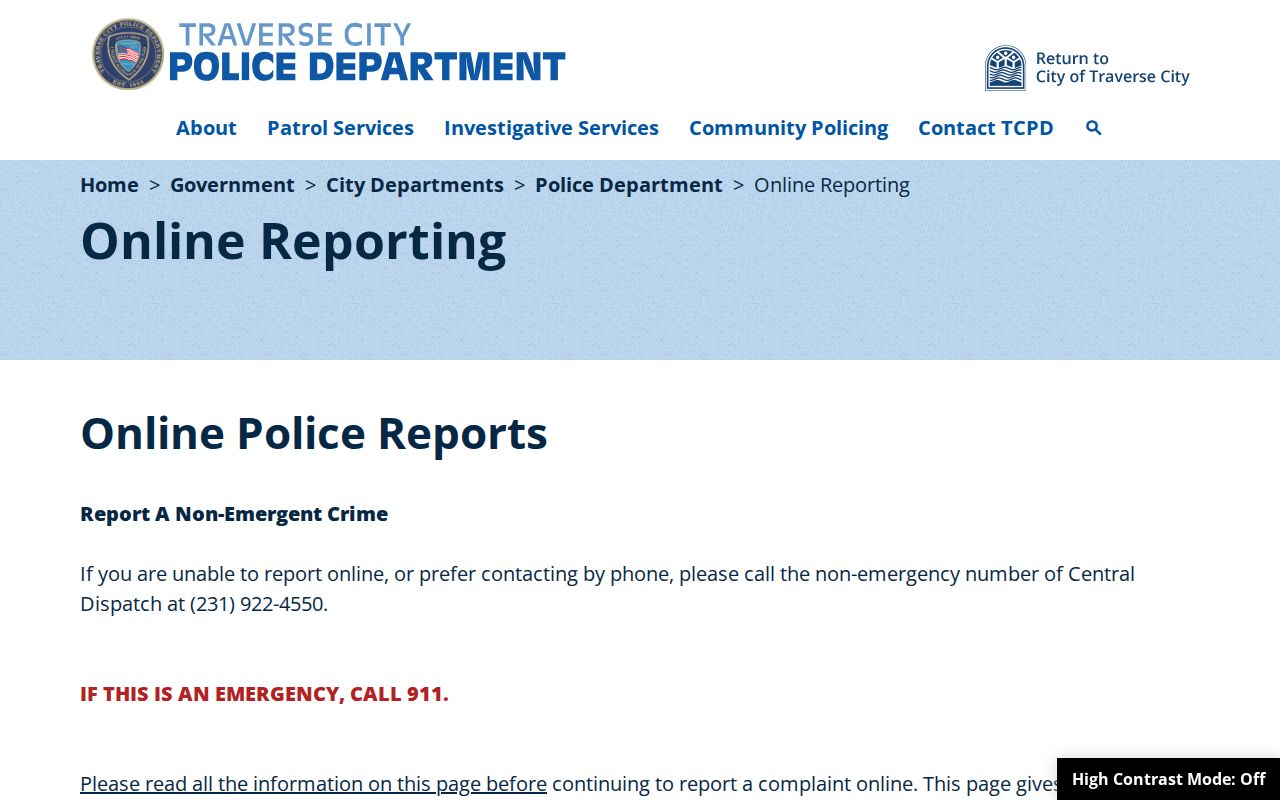
The published limits prevent readers from mistaking a report-intake form for a way to search existing Traverse City criminal records.
Traverse City Police Record Milestones
City history shows how local police records changed with operations. Traverse City incorporated as a village in 1891 and adopted its city charter in 1895. The first marshal began on October 1, 1895. Front Street traffic lights appeared in 1926, two-way police radio followed in 1938, and sector or community policing began in 1983. Body cameras arrived in 2021, creating a new class of digital evidence that a well-framed records request may need to name.
Police-social-work and Quick Response Team grants followed in 2022. In February 2026, the effort became RESILIENCE, retaining overdose follow-up and provider coordination while adding participant-led goals and broader outcome measures. These program records are not a separate public criminal-history database. Some material may be held by TCPD, while sensitive health, treatment, and personal details can be restricted.
Public Access Rules in Traverse City
Michigan law separates city police records from court records. TCPD responds to public-record requests under FOIA, subject to exemptions and redaction. Court files are obtained from the court clerk under Michigan Court Rule 8.119 and related law. ICHAT records come from MSP under the state criminal-identification framework. Sending one broad request to City Hall will not make it the custodian of county court or jail files.
Traverse City records can omit victim and minor data, Social Security numbers, other protected identifiers, sealed matters, and material whose release would violate an exemption. Describe the public record sought and let the custodian identify any withholding basis.
Key Michigan access rules:
MCL 15.231 states Michigan’s public policy favoring access to government records.
MCL 15.235 sets the ordinary five-business-day response and permits one ten-business-day extension.
MCL 28.243 supports Michigan’s criminal-identification reporting and dissemination framework.
Michigan Court Rule 8.119 governs court records and access subject to law and court rule.